




Fall Cohort begins in
--days
--hrs
--min
--sec
Friday, October 9, 2026

Join the priority list for Fall Cohort updates and enrollment first access.

A six-week live cohort for performance coaches

Building an Assessment System

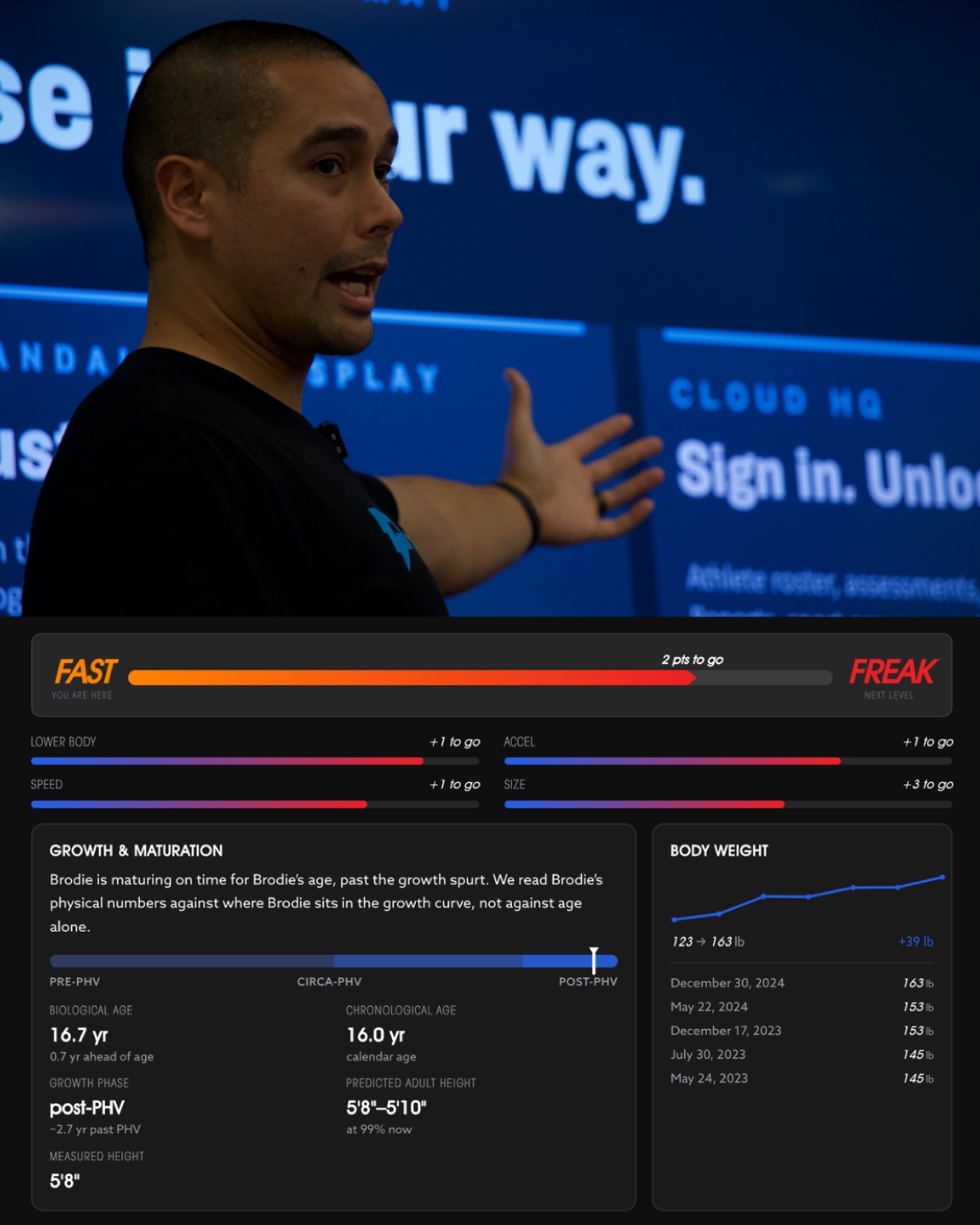
Rich Burnett presenting in front of the live assessment platform
Rich Burnett · Knoxville, TN

I have spent sixteen years figuring out how to test athletes, score them honestly, and let those scores decide the training. This fall I am teaching the whole system live to a small room of coaches, and every one of us builds a working version on our own athletes as we go. We will work through the decisions together, live, with recordings, recaps, and a discussion that continues between sessions.

Rich Burnett has consistently demonstrated a passion and desire to advance human performance through innovative, applied athletic assessment methods.
Dr. Jay DawesDr. Jay Dawes, NSCA Education Director

The inaugural cohort is underway. The Fall Cohort begins October 9, 2026.

Rich Burnett presenting in front of the live assessment platform
Rich Burnett · Knoxville, TN
Fall CohortBegins October 9, 2026
Six live weeksLive, recorded, and recapped
30 coachesCapped enrollment
$799One payment. No tiers or upsells.
Six live sessions

Modules and Builds

Built around decisions instead of lecture time. We retrieve the week’s essential idea, work a real coaching case, teach the framework, then spend the largest block building and critiquing your version. Weeks 4 through 6 move into Arkitect, where your Intake, Intel, and Insight specifications become a working application. Every session is recorded and recapped, so a missed live call is never a lost week.

Optional Table Talks

Table Talk

Coffee, cameras on, no slides, no agenda. We talk through your build, your athletes, the tool you are trying, and the standard you are second-guessing. Timing and cadence will be shared with the priority list before enrollment opens. In my experience this is where the best questions get asked.

What you will be able to build

Four working templates, one data foundation

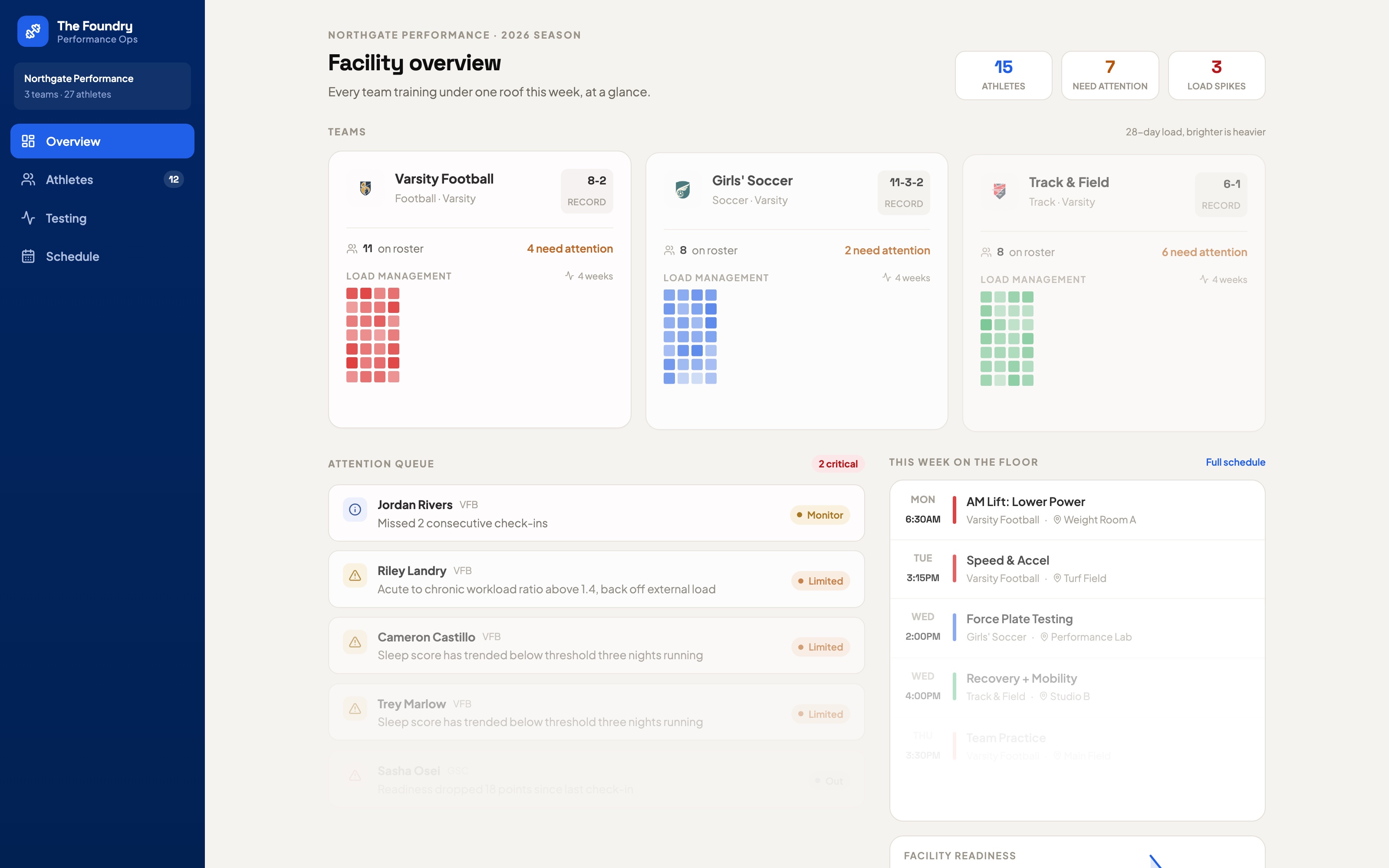
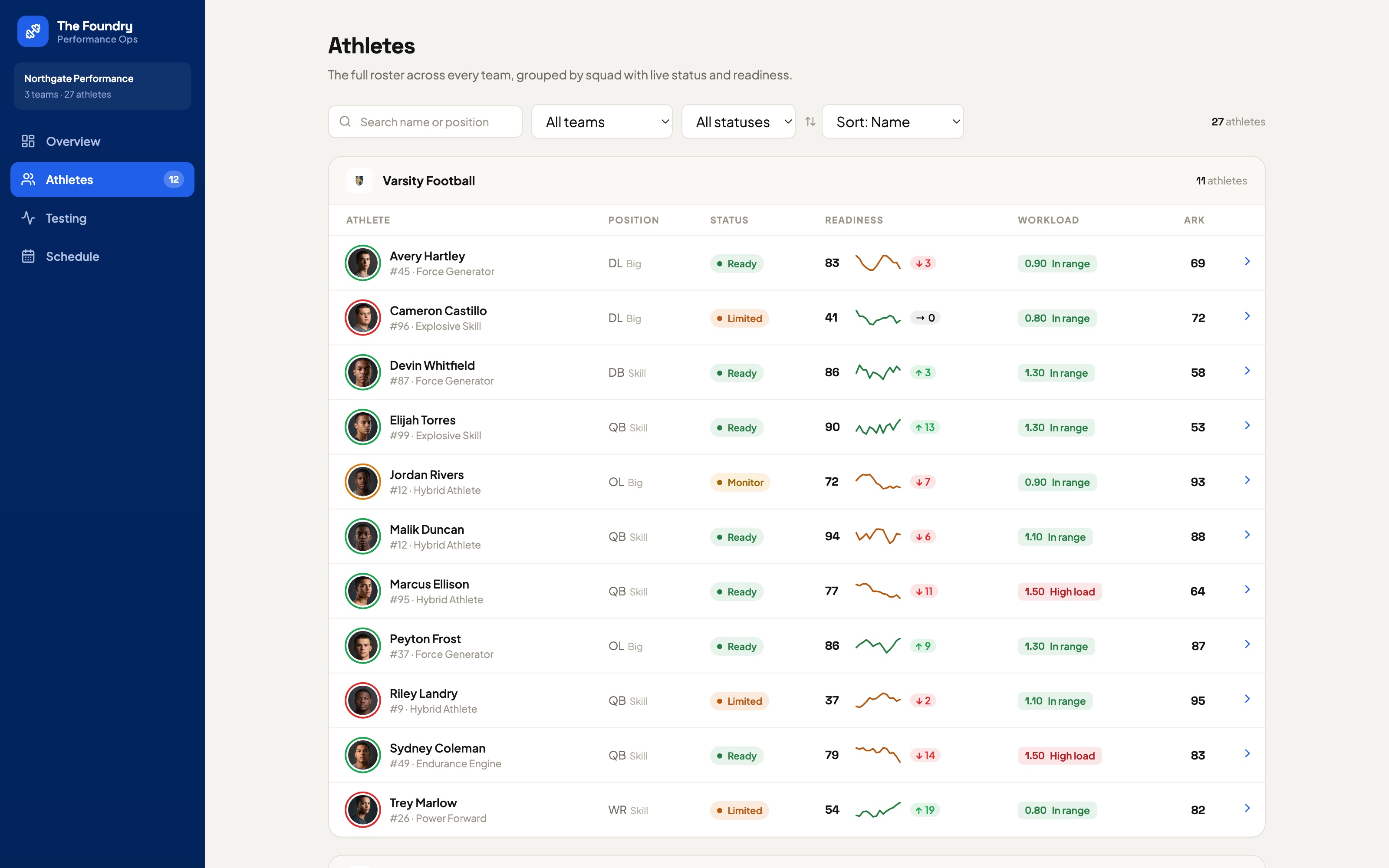
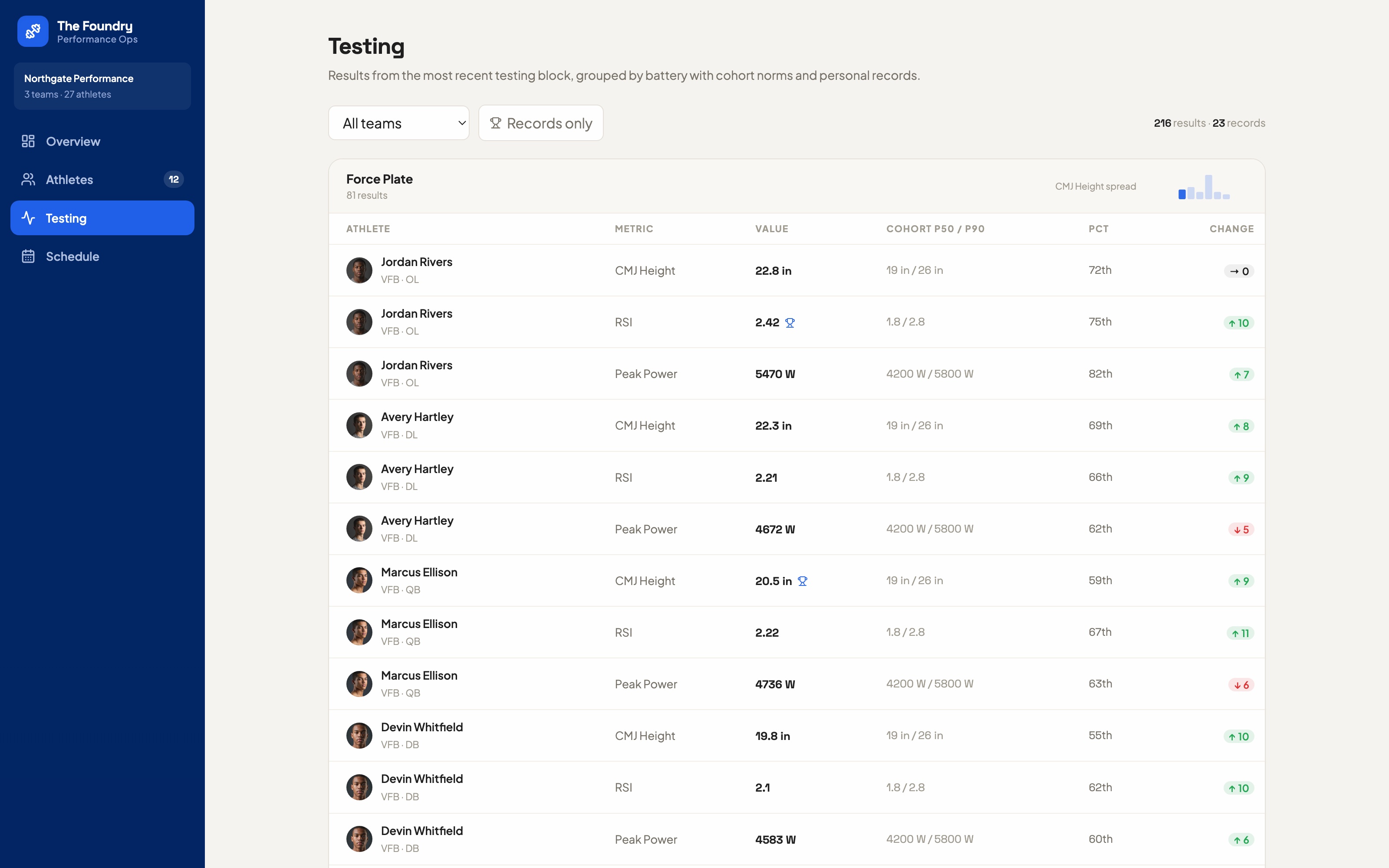
Four real, running interfaces built on the same assessment data your course teaches. Click any of them to load a live version.

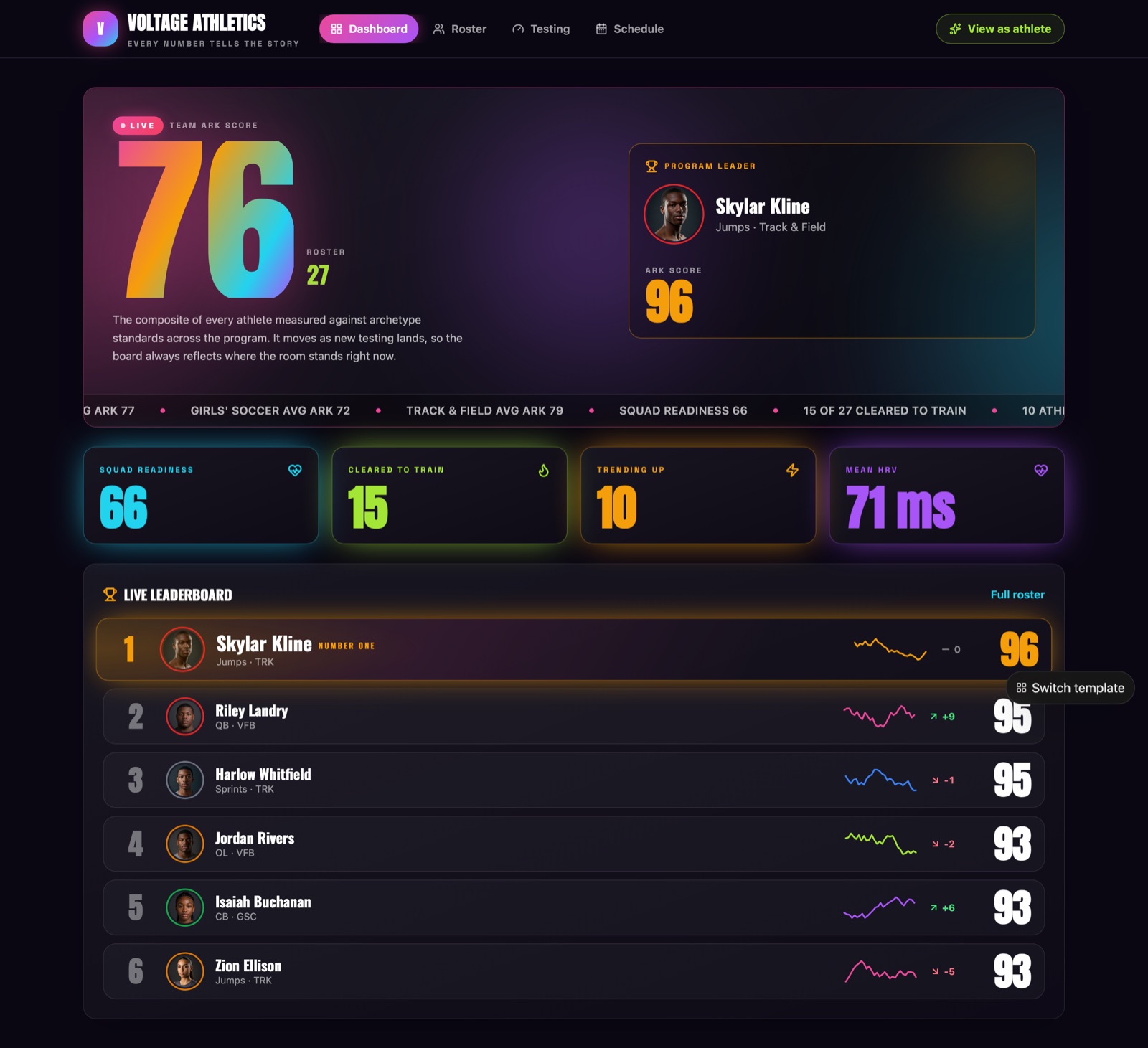
Marquee template poster screenshot

Marquee

A big-screen broadcast display for a lobby or a training floor wall.

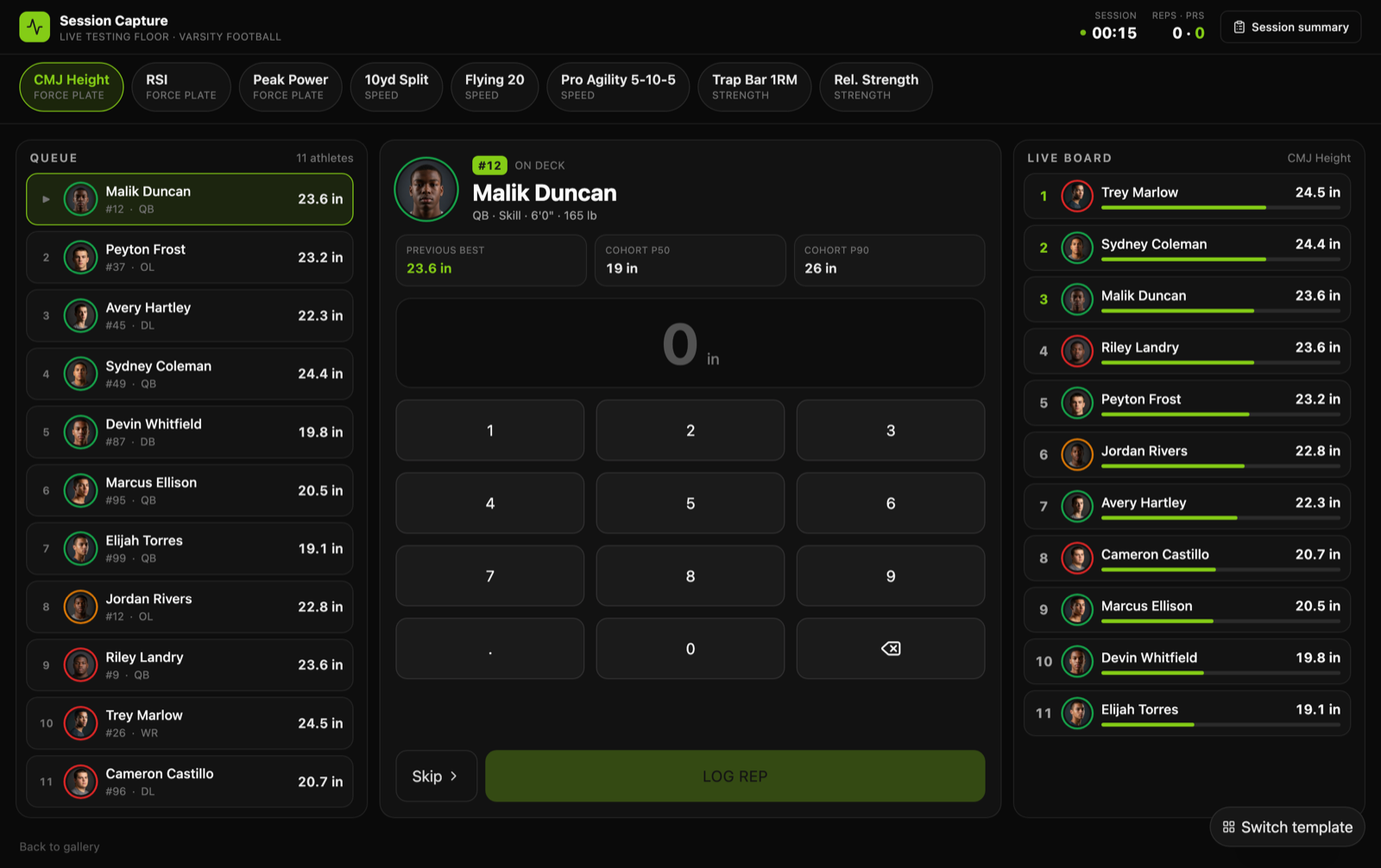
Session Capture template poster screenshot

Session Capture

Running a testing day live: log reps, flash personal records, keep the queue moving.

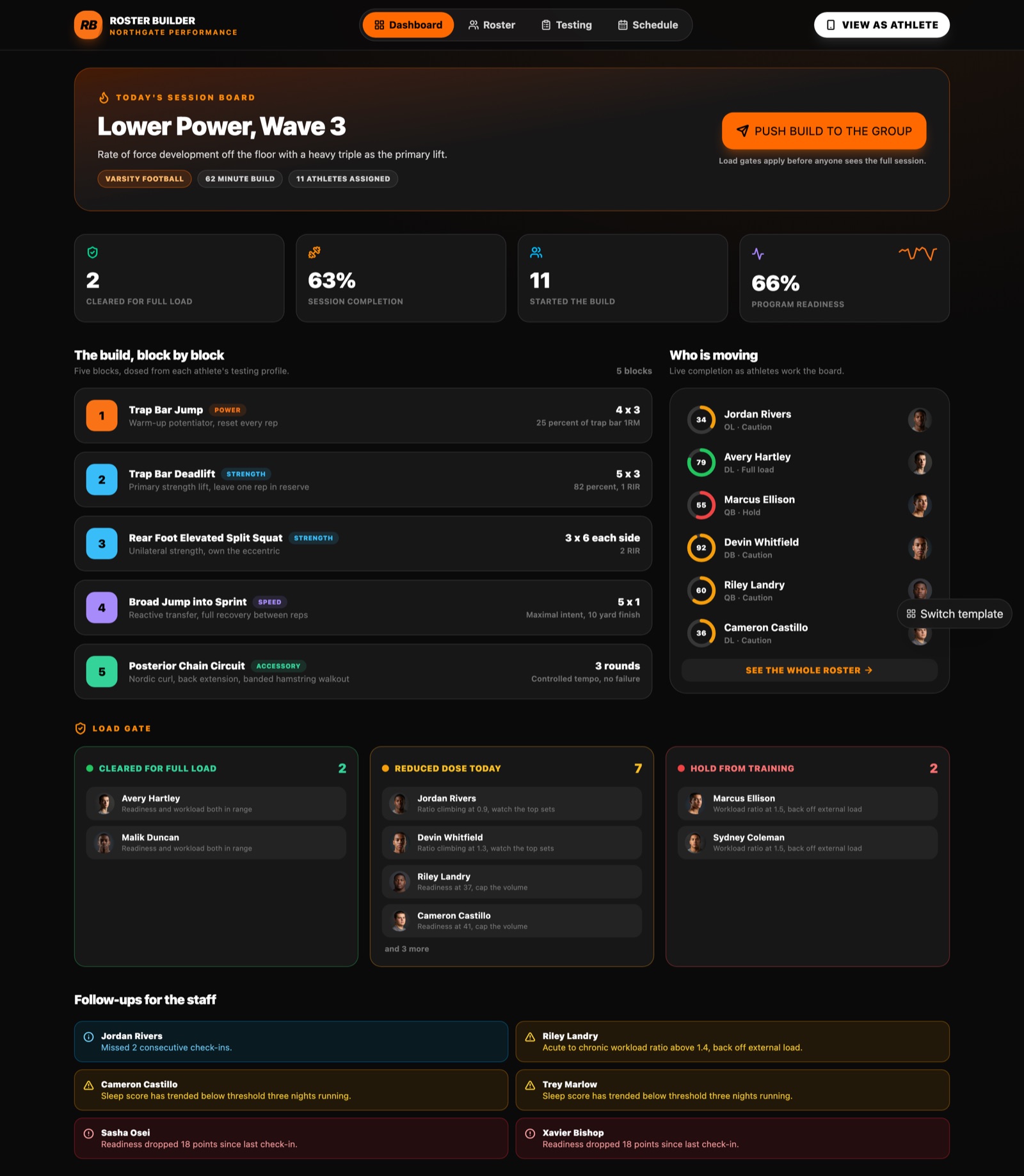
Roster Builder template poster screenshot

Roster Builder

Assign today’s session with real dosing math and a readiness gate.

Foundry Admin template poster screenshot

Foundry Admin

The facility admin a busy strength coach lives in all day.

The room

Nobody builds this alone

The honest reason to join a cohort instead of buying another video course is the other coaches. A room of us, building assessment systems at the same time, on wildly different populations.

Someone posts the report they just built and asks whether a parent would actually get it.

Someone shares the tech stack that finally worked.

Someone’s standards come out weird and other coaches spot why before Friday.

That back and forth is where this course actually lives. The space stays open after the cohort ends, because everyone in it is still running their system and the comparing does not stop when the course does.

First draft of my before and after report. Be honest.

How the discussion runs
Adam Atallah

Finished my first retest report build tonight. Before and after for a 15 year old I have had since March. Screenshot attached. Would you actually hand this to a parent, or is it too much?

👀 2
Cody Hughes

This is clean. Two things. Lead with the 5-10 fly, not the vert. A parent does not know what a good RSI is, but faster is faster. And flip your tier colors. Right now Foundation reads like the top of the mountain and Freak looks like a warning label.

🔥 3💯 1
Rich

Agree with Cody on the order. This report has one job: show the kid got better and make it undeniable. Biggest win at the top, numbers rounded so they land, and I would cut the third chart entirely. Bring it Friday and we will put it on screen and walk it together.

🔥 4
What you get

What you walk away with

Six live sessions with the whole room

Focused teaching, one coaching case, guided work, peer critique, and a visible decision checkpoint each week.

Every session recorded and recapped

Live sessions and Table Talks. Miss one, watch the recap, and show up to the following session ready to build.

Your own working build

Starting in Week 4, Arkitect turns your specifications into a hosted synthetic build. You test one complete workflow, preserve the source history, and finish with a clear choice between hosted continuation and participant owned source.

The room

Coaches who built this with you, still comparing standards, reports, and tech stacks after the course. The discussion space stays open when the course ends.

The reference library

The research behind every framework in the course, cited and collected, so your system stands on more than my opinion.

Enrollment

$799, one payment.

Fall Cohort begins October 9. Join the priority list for the live-call time, complete calendar, and first access when enrollment opens.

Join the Fall Cohort waitlist
Built with the inaugural cohort

34 coaches in the inaugural room

Rich Burnett

RichHost

Jonmarc Rasberry

Jonmarc

Robert Lopez III

Robert

AS

Angel

Cody Hughes

Cody

adam

adam

C

coach

EP

Elmer

Travis Webb

Travis

JJ

Jordan

BV

Brett

D

danielchandler27

Rob Brokaw

Rob

John Bloom

John

LE

Liam

NM

Nathan

Patrick Nolan

Patrick

Brian Sutton

Brian

Missy Mitchell-McBeth

Missy

David McDowell

David

JL

Justin

MM

Mark

JT Rankin

JT

Robbie Cole

Robbie

Bubbe Reynolds

Bubbe

Tyler Dobratz

Tyler

Jeremy Evans

Jeremy

Henry Barrera

Henry

BR

Brandon

CC

Colin

AC

Ashley

BB

Brian

AD

Alex

Tom Callow

Tom

Why assessment

Assessment creates commitment

Most of us have been guessing and half tracking for years, squinting at a spreadsheet and calling it a system because the alternative is admitting we do not actually know. There are two reasons I stopped doing that. The first is so I know what each kid actually needs instead of handing everyone the same program. The second one stuck with me from Ernie Reimer years ago: any good strength coach should be willing to audit their own body of work and make sure it is actually working. This course is not a new sport. It is the same tests and the same athletes you already have, run through a system that is prettier, faster, and easier to defend, so the numbers finally make sense instead of just sitting in a tab you dread opening. Everything in this course comes off those two reasons, taught from sixteen years of building the system, including the mistakes that cost me seasons of data.

A real athlete profile report generated by the assessment system this course teaches
What your grades are for

Program Allocation

Grades are worth nothing if they do not change training. Program Allocation turns the result into an assignment for what an athlete needs most. Foundation is movement quality first. Fit exposes quality movement to fatigue through volume. Fortified pursues high strain through load. Fast turns relative strength into power and high outputs. Freak uses complex patterns, broad exposures, and high performance maintenance. These are coaching buckets, not personality labels and not permanent identities. Every active bucket must map to an explicit dose, emphasis, or review rule.

FoundationMovementFitVolumeFortifiedLoadFastPowerFreakComplexity

The bench protocol

15%30%45%60%75%90%105%estimated 1RMbar velocitystage, percent of bodyweight

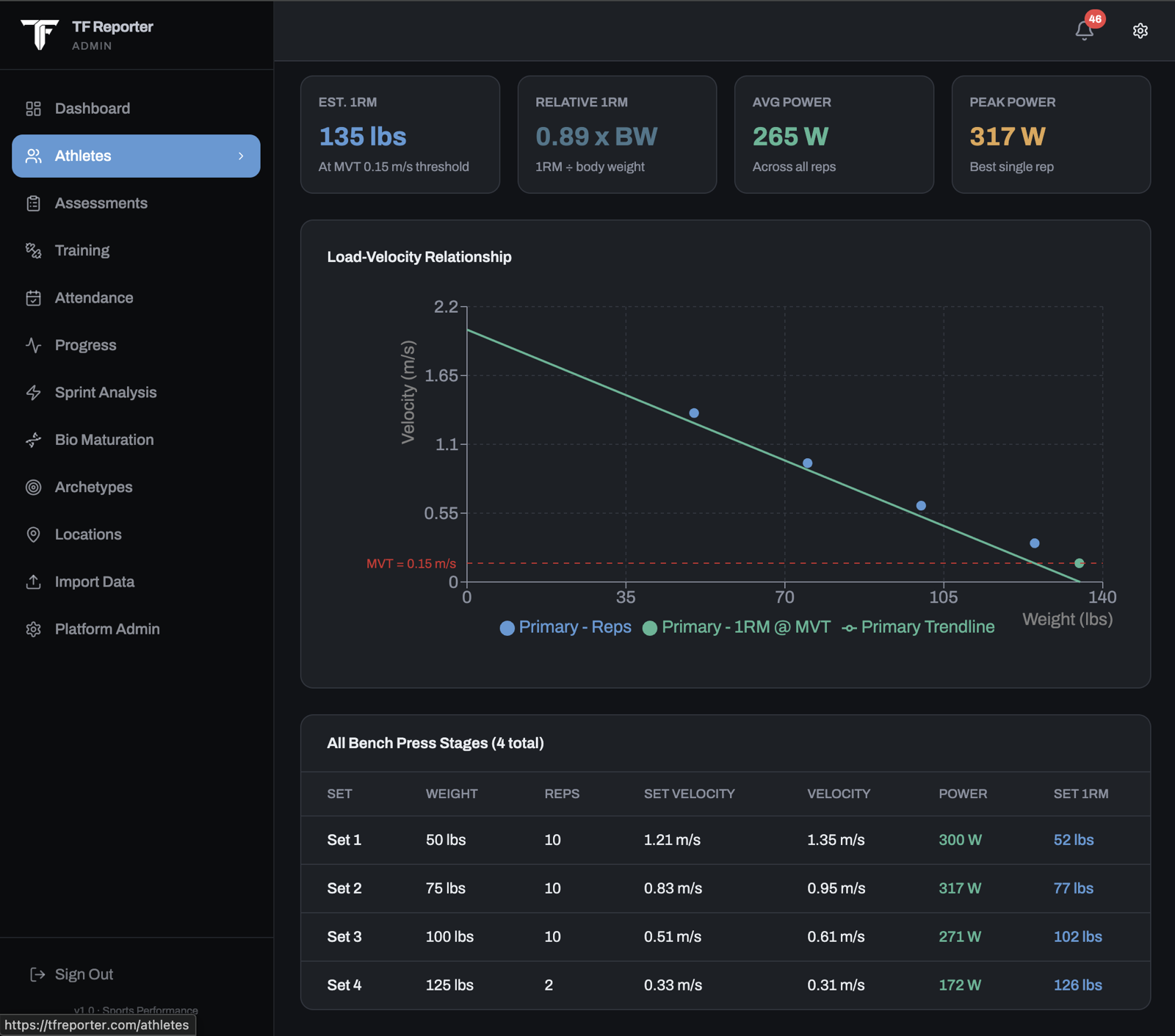
Bar velocity at stages of bodyweight, 15 to 105 percent, with a regression across completed stages predicting max regardless of where the athlete stops. The athlete watches live which step their bar speed is trending toward, and the retest conversation stops being only about the max.

Velocity at each bodyweight stage, regression to estimated one rep max.

Asymmetry and the bilateral deficit

RSI, left vs rightLR20% gapDouble leg vs single legDLSL avgdeficit

Double-leg against single-leg reactive strength, left against right, and what the gaps actually justify changing in training. Thresholds that mean something instead of alarm bells on every athlete.

The six weeks

Scope it, then build it

The Fall Cohort begins October 9. Six live sessions build the complete specification through Intake, Intel, and Insight, then use Arkitect to scope, wire, test, ship, and establish ownership of the working application. Live-call details will be shared with the priority list before enrollment opens.

Week 1October 9

Intake

Choose tests that earn floor time, separate recorded, calculated, and scored results, and keep unfinished protocol or collection work visible until it is ready.

You leave withA committed Intake Blueprint at an honest Ready for Intel, Collection Ready, or Operations Ready milestone.
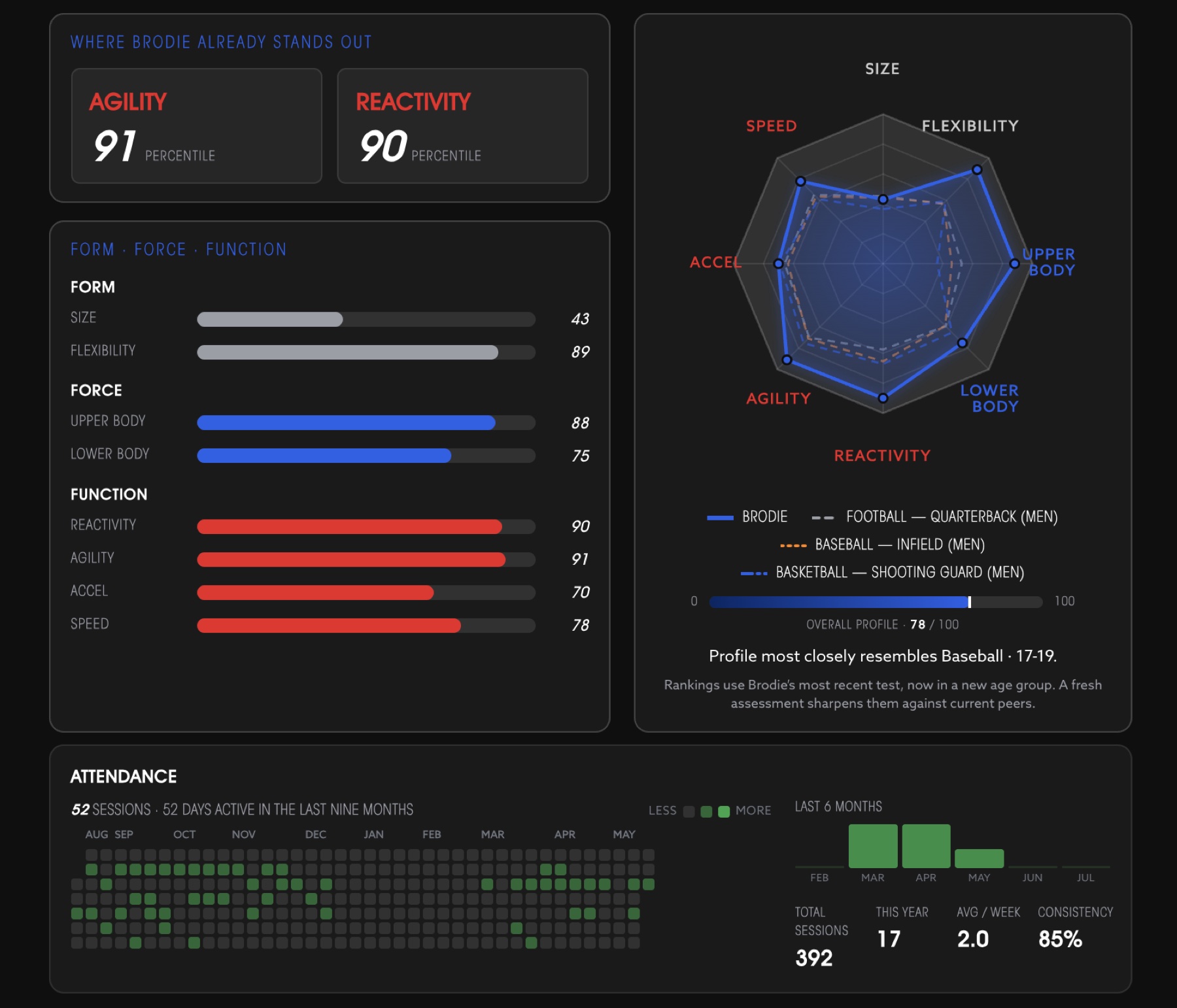
Sample athlete report from the Triple F system, showing scored qualities and a written summary
Week 2Fall schedule

Intel

Turn raw results into fair comparisons. Scope standards to the decision, use percentiles as drafts, apply allometric scaling only where size bias is real, keep maturity as context, and make uncertainty visible.

You leave withAn Intel Ruleset and one complete Studio scoring route another coach can inspect, defend, and use.

Bench press velocity profile screen from the Triple F system
Week 3Fall schedule

Insight

Connect signal to meaning to action, design reports for coaches, athletes, and parents, and turn Program Allocation into explicit training decisions.

You leave withAn Insight Decision Spec with report logic, allocation rules, overrides, retest cadence, and audit triggers.

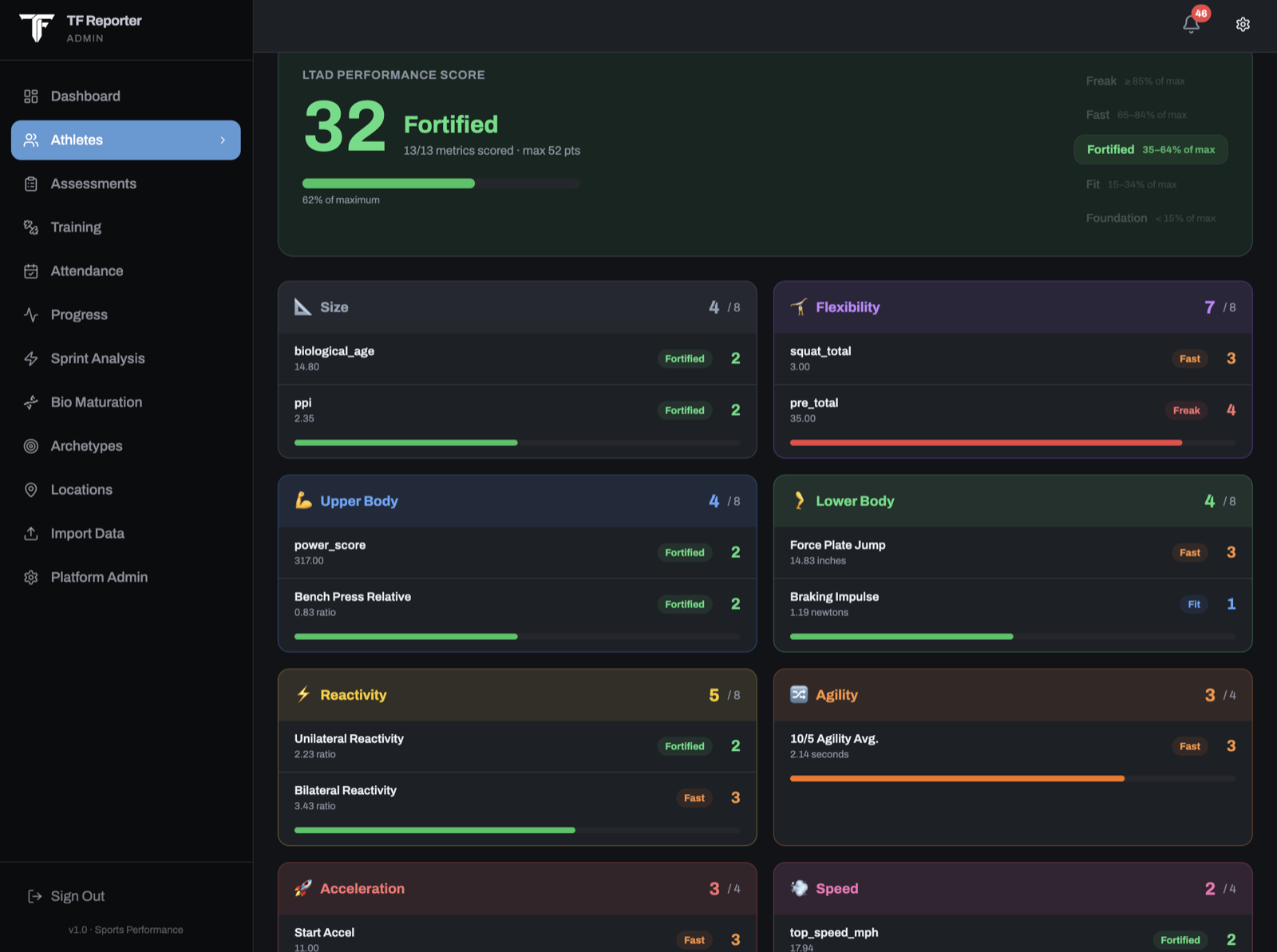
LTAD score breakdown screen showing a scored quality profile
Week 4Fall scheduleBuild week

Arkitect I: Scope The Build

Publish the committed Assessment System Manifest, verify its Intake, Intel, and Insight provenance, choose the Platform and Look, then inspect the first hosted synthetic build.

You leave withA version pinned system manifest, an Arkitect Build Brief, and a first build that completes one real interaction.

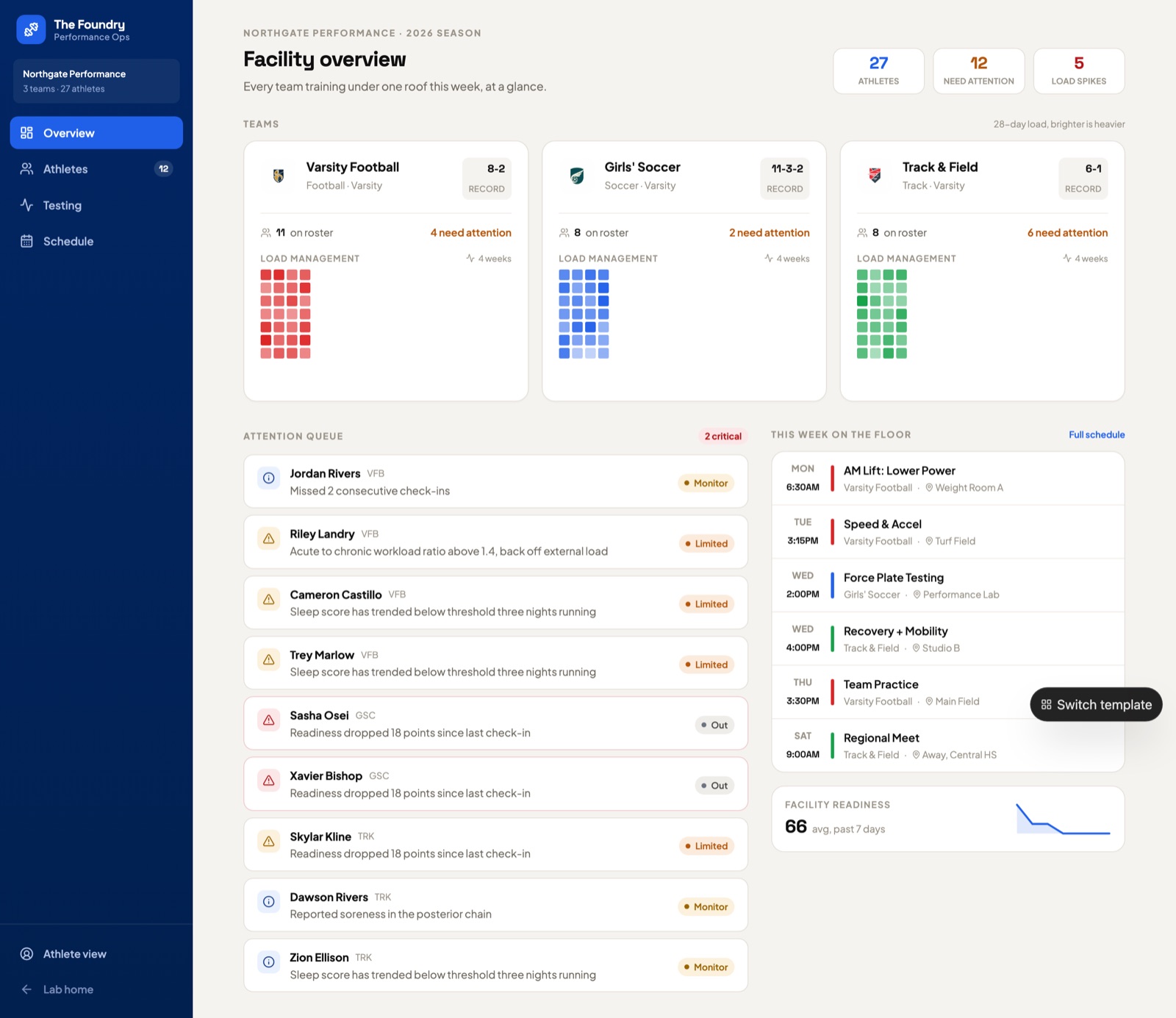
Foundry Admin template, move-in and facility overview screen with team cards and load heatmap, week 4 of your build
Week 5Fall scheduleBuild week

Arkitect II: Wire The System

Wire Intake validation, Intel context, and Insight decisions into one loop. Test the happy path, boundary values, missing inputs, provisional standards, overrides, and recovery.

You leave withAn Arkitect QA Scorecard and a synthetic workflow that passes the agreed end to end test.

Foundry Admin template, wired to training with tiers and decision rules on screen, week 5 of your build
Week 6Fall scheduleBuild week

Arkitect III: Ship, Own, Operate

Pass the ship gate, present the capstone, choose hosted continuation or source export, and establish ownership, backup, privacy, support, and audit responsibilities.

You leave withA working application and a Ship, Own, Operate Plan for the next ninety days.

Foundry Admin template, running system ready to present to the room, week 6 of your build
Proof, not slideware

Real reports from the system this course teaches

Athlete report from the Triple F system
Athlete report
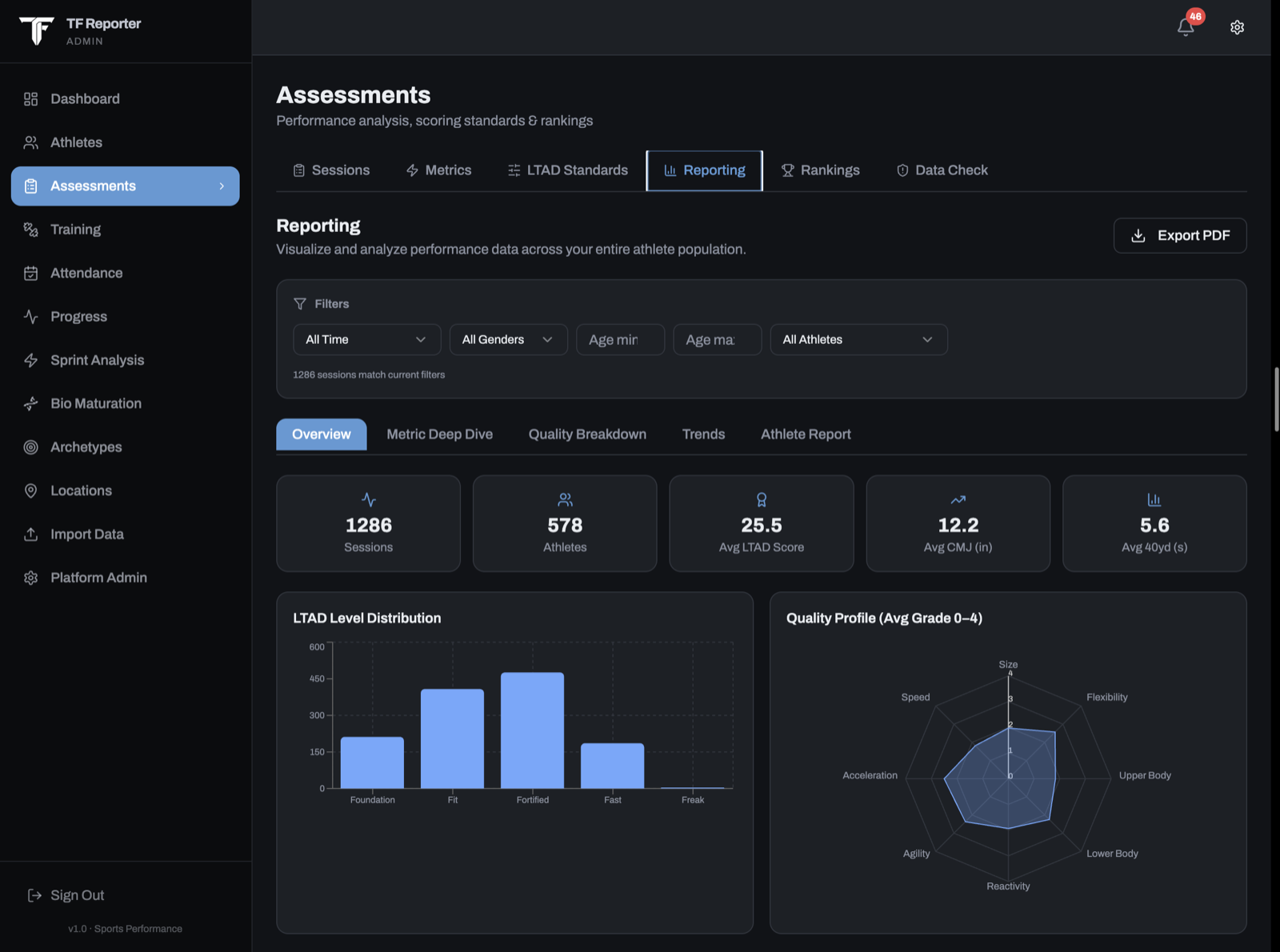
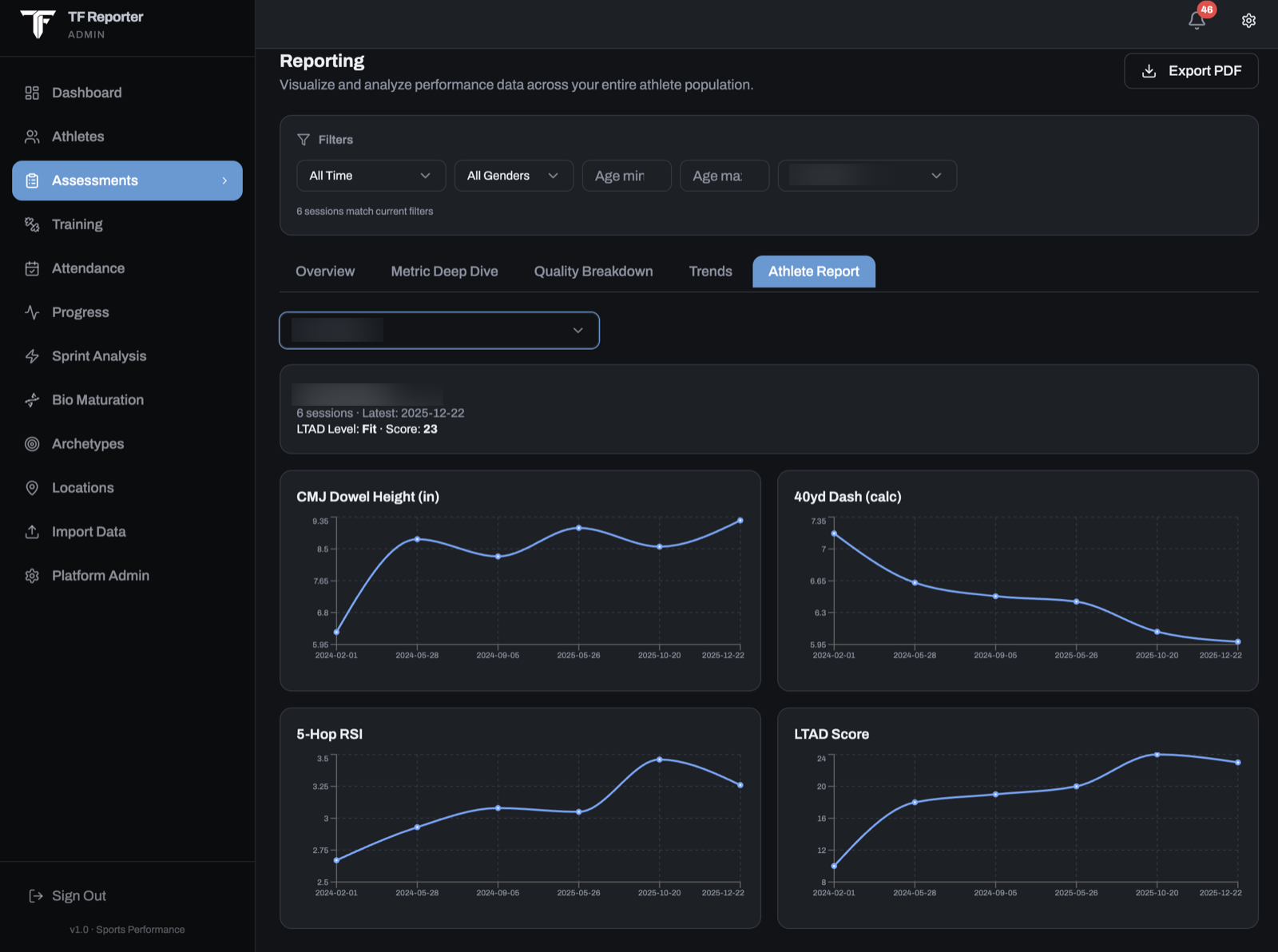
Assessments and reporting screen from the Triple F system
Assessments and reporting
LTAD score breakdown from the Triple F system
LTAD score breakdown
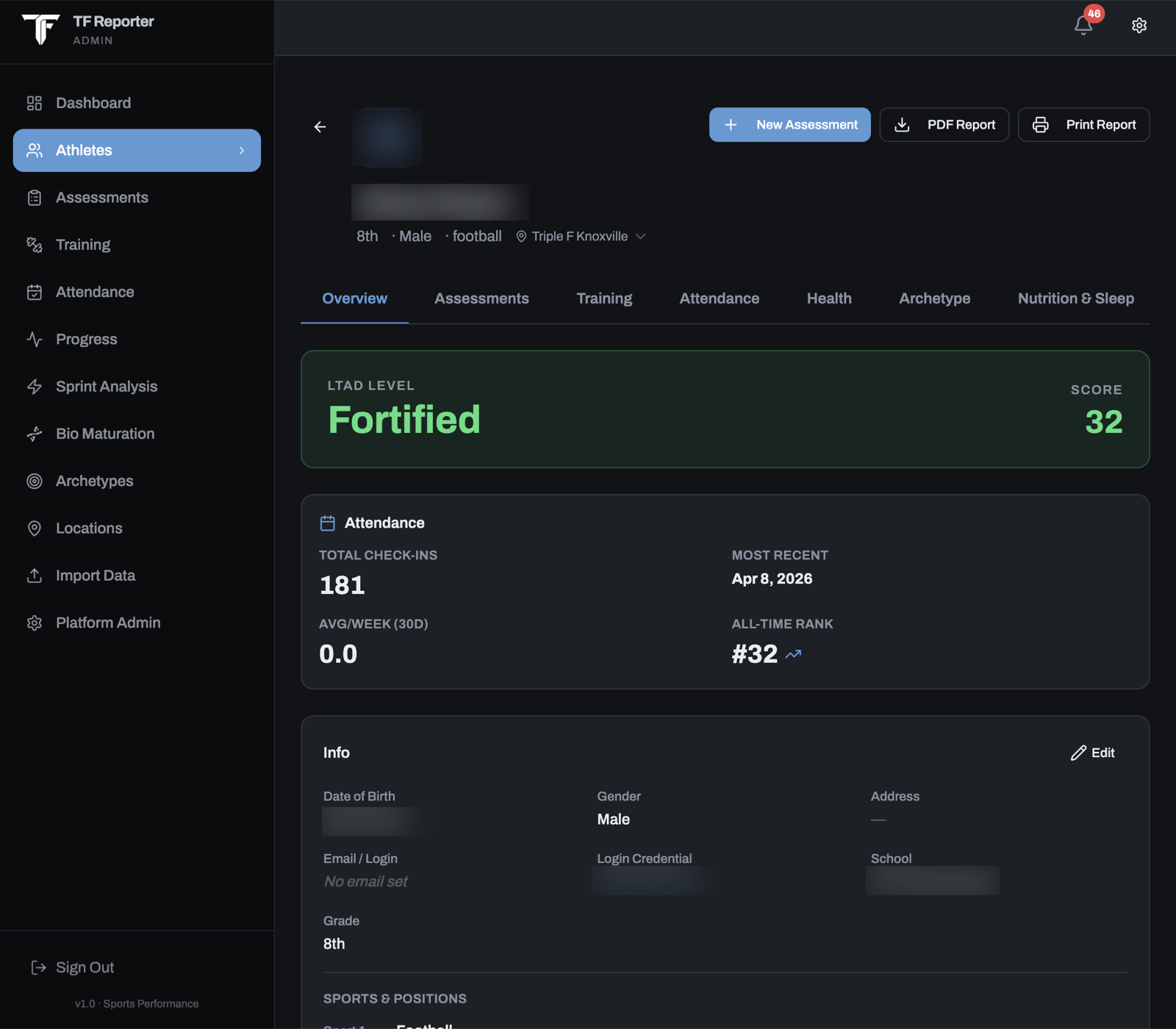
Athlete card from the Triple F system
Athlete card
The workspace

The same platform as the course

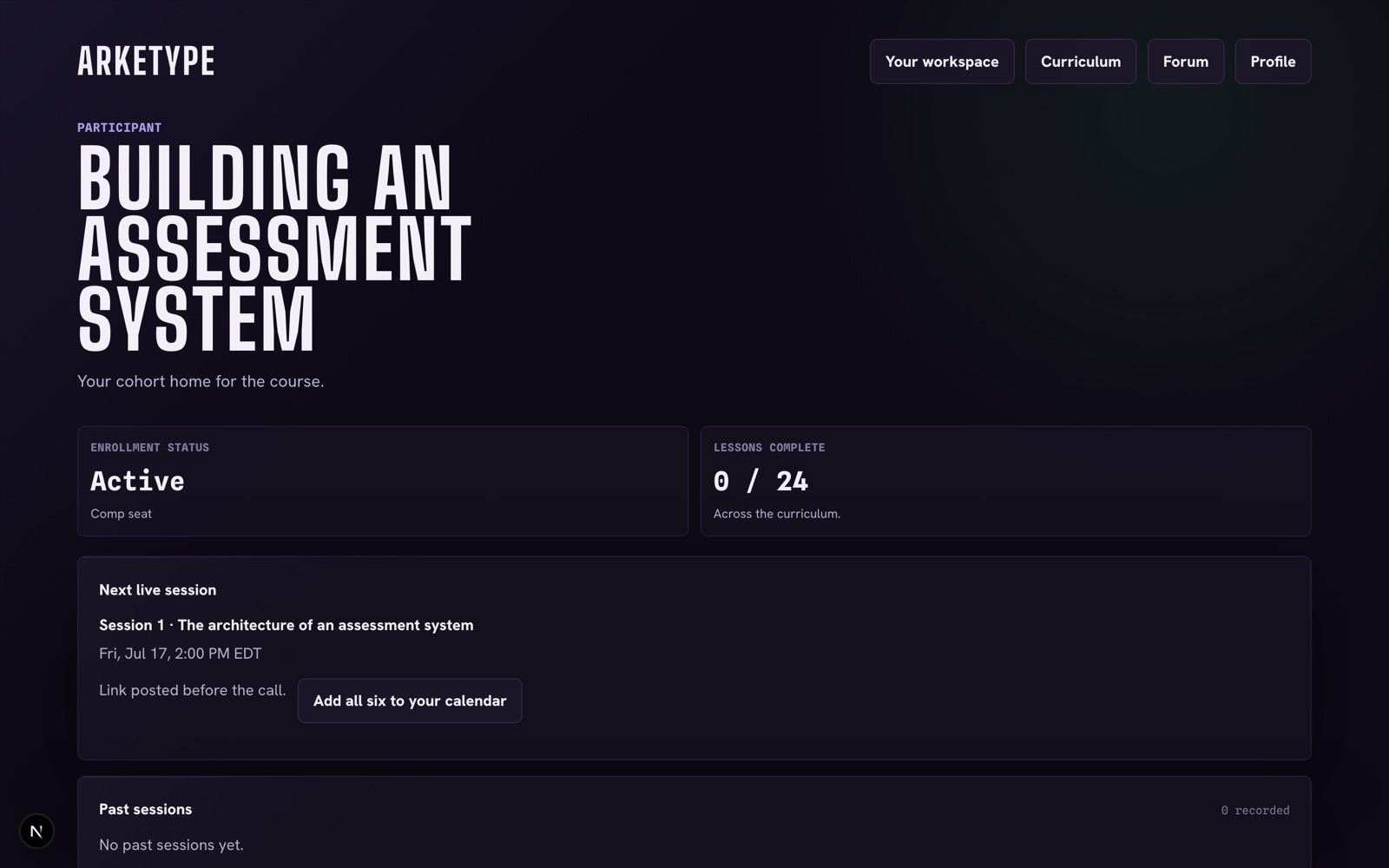
Your cohort home holds the curriculum, the live schedule, the recordings, the discussion, and from week 4, your build. It is the same platform your assessment system runs on, so learning the tool and building your system are the same act. You will also see the other builds taking shape, which is half the fun.

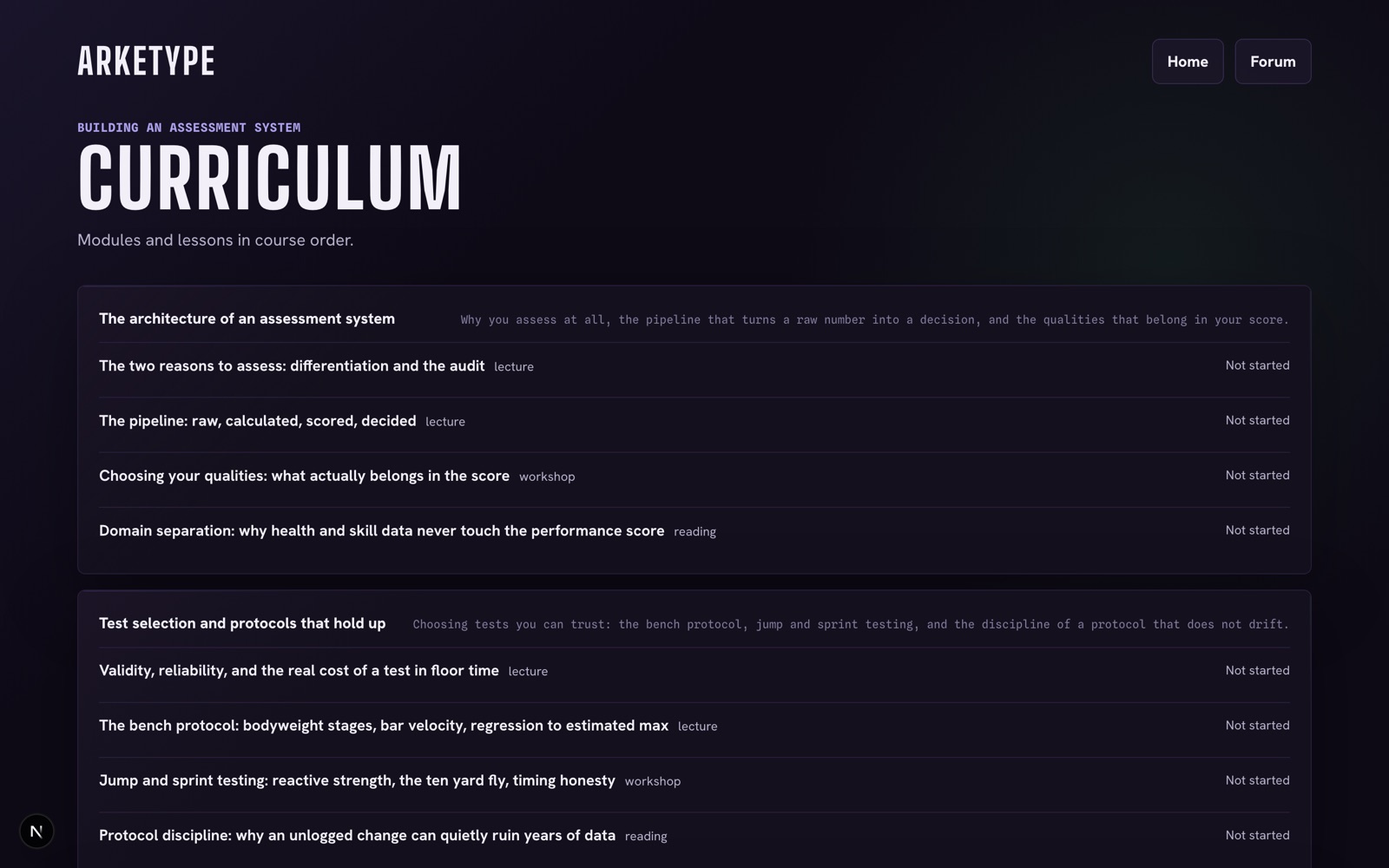
Cohort platform curriculum screen
Curriculum
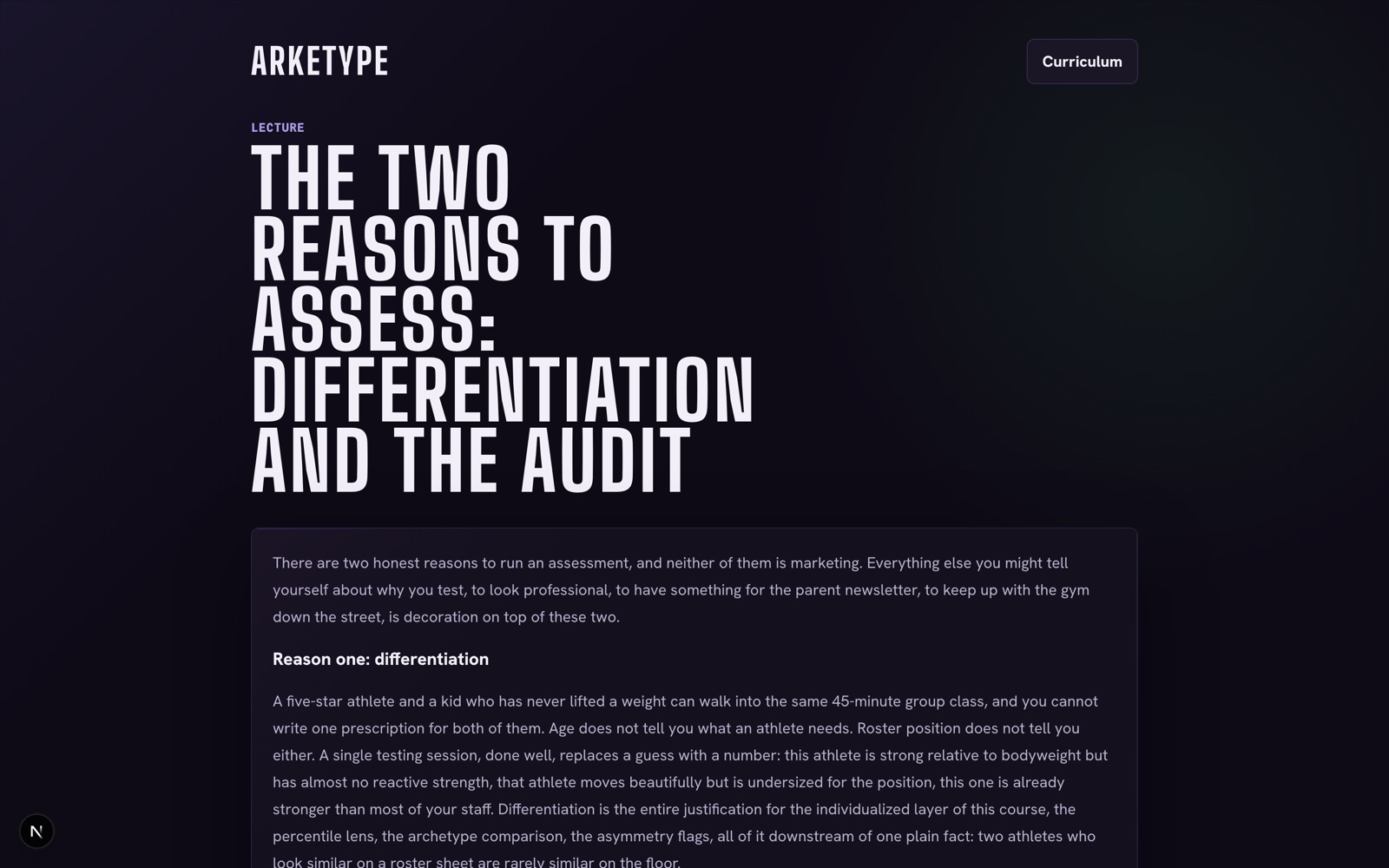
Cohort platform lesson screen
Lessons
Cohort platform home screen
Your cohort home
Beyond the six weeks

What this can become

You do not rent this system. You build it, and at the end of six weeks you get the keys, the same way a homeowner gets the keys to a house they built. What you do with the keys is yours to decide.

Integrations

Your force plates, timing gates, and spreadsheets feeding one system instead of living apart.

A staff app built on your system

The same Intake, Intel, and Insight rules you build in the course, in front of your staff on the floor.

Internal communications

One place your staff sees the same numbers you do, instead of a group chat full of screenshots.

Athlete-facing views

Reports and scores an athlete or a parent can actually read, built from the same data.

Who is teaching

Sixteen years of building this, not talking about it

SCCC, CSCS, APCC, CAFS, M.S. Kinesiology

Rich Burnett is an SCCC, CSCS, APCC, and CAFS-certified strength and conditioning coach with an M.S. in Kinesiology, sixteen years into a career that runs D1 head strength coach at Texas A&M Corpus Christi across seven sports, Head Strength and Conditioning Coach at Greater Atlanta Christian, and now Director of Athletic Development at Triple F in Knoxville, where he leads NFL Combine training.

He is also the founder and CEO of Plyomat, a jump and force measurement ecosystem used on real training floors, and he built the Triple F app end to end, the same athlete-data platform this course runs on. He is a published researcher, including work co-authored with Jay Dawes. The standards taught in this course come off more than 79,000 test results and 3,000-plus athletes trained, the assessment system he has been running and refining at Triple F the whole time.

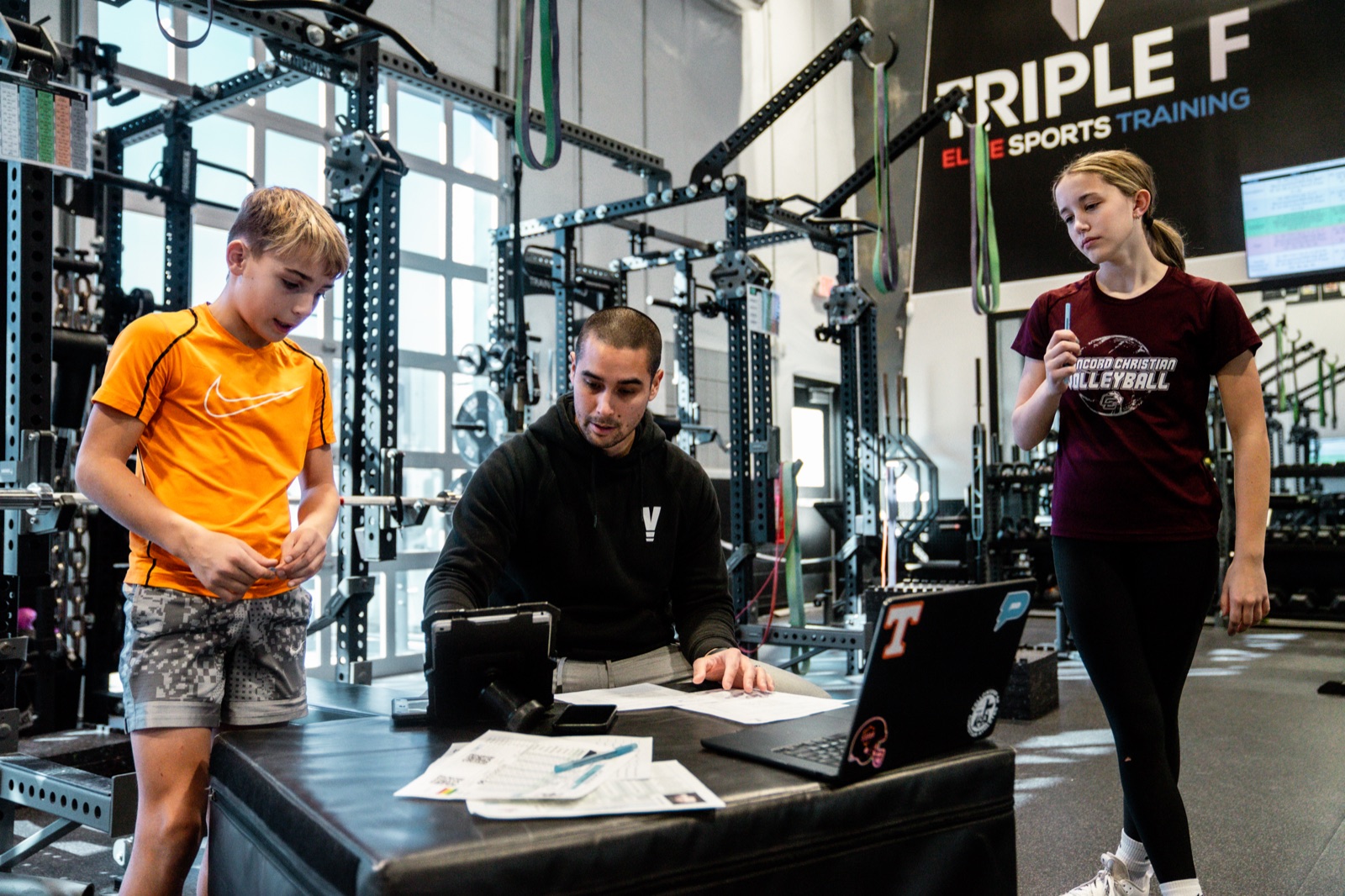
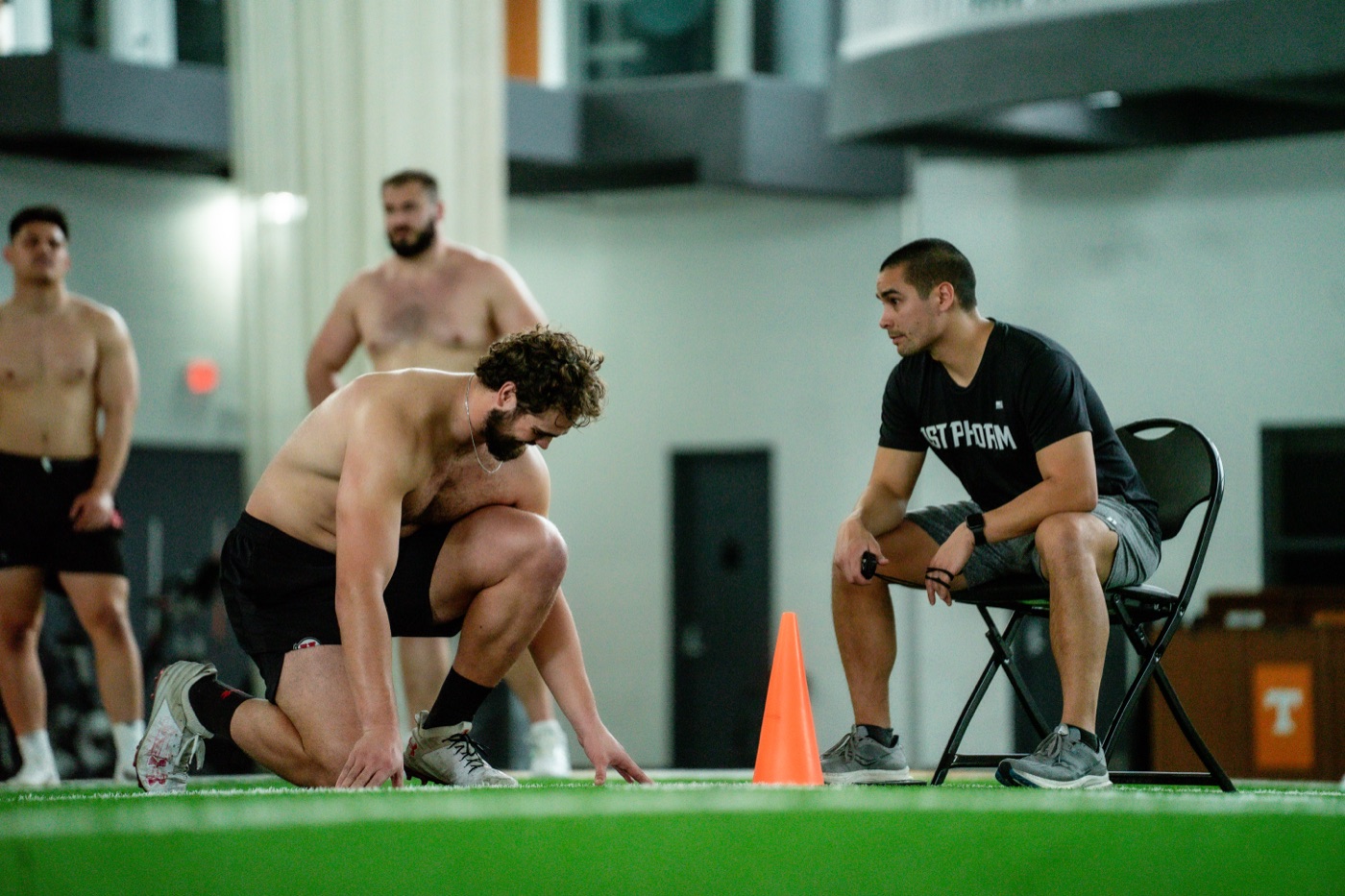
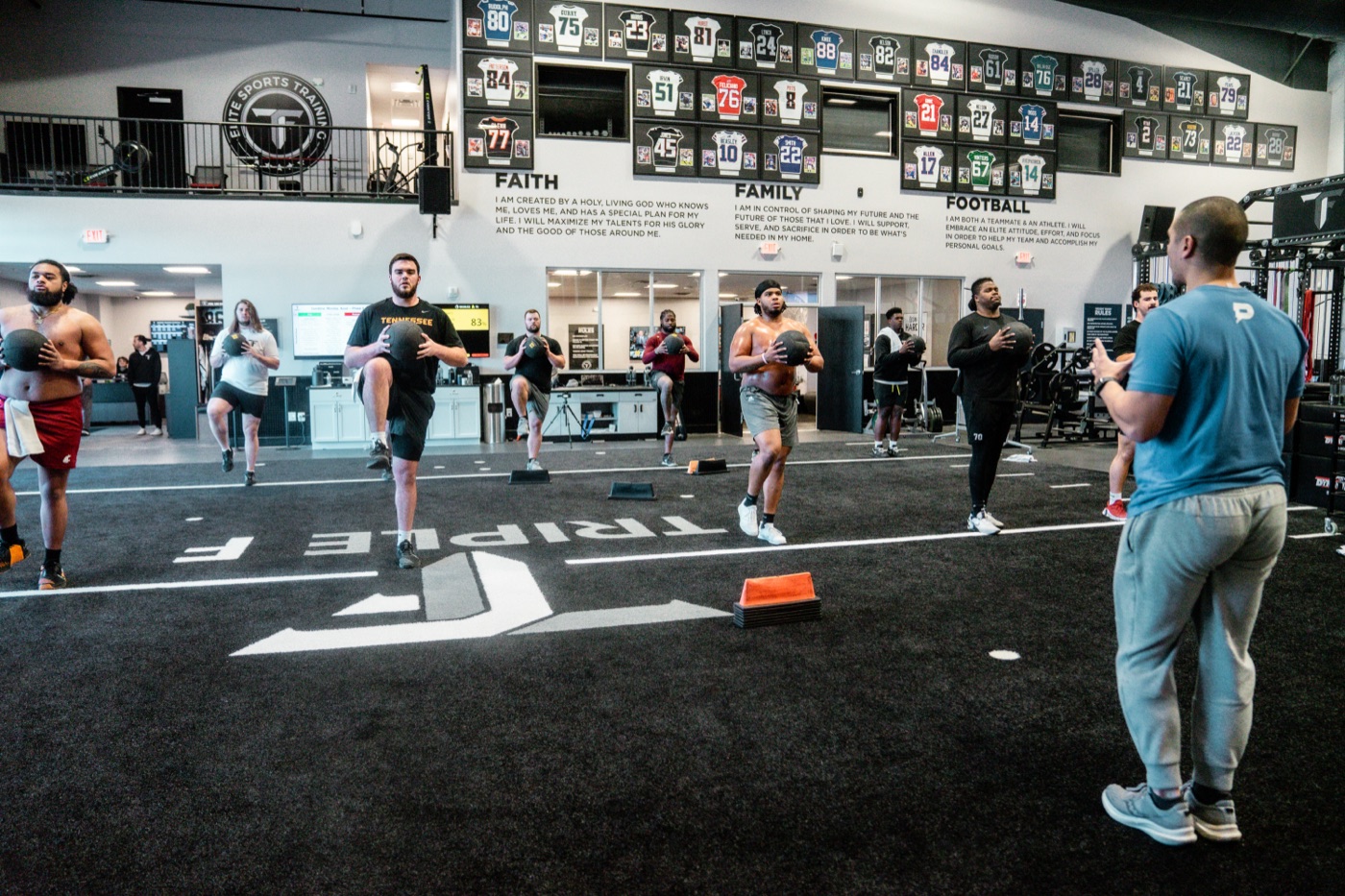
Rich Burnett coaching a group of athletes during a training session
16years coaching
3,000+athletes trained
79,000+test results behind the standards
Rich Burnett coaching on the training floor
Rich Burnett working with an athlete during a testing session
What coaches say

Endorsed by the people who do this work

Rich is one of the best performance coaches that I’ve collaborated with. He takes a progressive and forward-thinking approach to building an athletic performance system. What stands out most is his ability to blend practical coaching experience with structured, data-driven evaluation methods.
Collin Crane

Collin Crane

UGA Men’s Basketball S&C

Quality athlete assessment is the foundation of everything we do as performance coaches. Rich Burnett gets that; and more importantly, he’s built a course that teaches it in a way that’s immediately applicable, regardless of your level or your setting. This is the kind of professional development that actually moves the needle.
Donnie Maib

Donnie Maib

Assistant Athletics Director for Athletic Performance, University of Texas

Rich is in a tier of his own as a human being and a strength coach. One of the most humble and knowledgeable people that you’ll meet. If you want to learn from someone that has been in the trenches and knows how to develop complete athletes...he is your guy.
Andy Fata-Chan

Andy Fata-Chan

Owner of Moment PT

Rich is an elite coach and thinker who consistently pushes sports performance forward with innovation and creativity. Sticking to what breeds results while challenging the status quo has allowed him repeated and long lasting success in developing athletes. The depth of his approach to assessment and implementation of problem solving separate Rich from the masses.
Tylor Henry

Tylor Henry

Notre Dame Football S&C

Fall 2026

The next cohort begins October 9.

Building an Assessment System returns as a six-week live cohort beginning Friday, October 9, 2026. Join the priority list for the schedule, live-call time, and first access to enrollment at the standing $799 price.

See Fall Cohort details
Enrollment

Fall cohort begins October 9.

July cohort closedFall 2026
$799

One payment for the complete six-week cohort. No tiers and no upsells.

The Fall 2026 cohort begins Friday, October 9. Join the priority list for the live-call time, complete schedule, and first access when enrollment opens.

Fall priority list open

Joining the priority list does not charge you. Fall enrollment will be offered at the standing $799 price.

This course is for you if

  • You coach real athletes and you are done guessing: private facility, high school, college, or team setting.
  • You have testing data, or want it, and you know a spreadsheet is not a system.
  • You want your athletes chasing a score they trust, and you want to defend that score to any parent, AD, or director who asks.
Building an Assessment System · A live cohort taught by Rich Burnett · Fall 2026 · More from Rich